


News
Simulation Reveals How Rotating Solar Spicules Form and Transport Mass and Energy
Solar spicules are slender jets commonly found in the chromosphere. They lift relatively cool plasma from the lower solar atmosphere and carry energy upward, and some rotate as they evolve. Small-scale vortices also frequently occur between convection-driven granules in the photosphere.
Two questions remain incompletely understood: how these photospheric vortices help form spicules, and how much mass and energy the rising jets carry into the corona. Now, three-dimensional radiative magnetohydrodynamic simulations have traced the formation of a rotating spicule-like jet to a photospheric vortex. The work was carried out by GONG Liufan, NI Lei and CHENG Guanchong at Yunnan Observatories of the Chinese Academy of Sciences (CAS), together with collaborators at the University of Science and Technology of China and the University of Sheffield in the United Kingdom. The researchers show that the vortex twists the magnetic field and, together with the small-scale magnetic reconnection it induces, drives the jet, and they quantify the mass and energy the jet transports into the lower corona. The study was published in Astronomy & Astrophysics.
Using the MURaM code, the team performed three-dimensional radiative magnetohydrodynamic simulations in an open magnetic field, with a computational domain extending from the upper solar convection zone to the lower corona. Several spicule-like jets associated with vortex motions emerged in the simulations. The researchers selected a representative event lasting about 10 minutes and traced its formation. Before the jet appeared, a photospheric vortex twisted the magnetic field lines. The rotating structure then developed upward into higher atmospheric layers, forming a "magnetic tornado." The jet gradually rose within this structure and rotated around the same axis.
At the tornado's periphery, the twisted magnetic field lines developed locally downward-directed components and reconnected with upward-directed fields in both the surrounding background and the vortex core, changing their connectivity. Thin current sheets and bidirectional outflows appeared at different stages of the event—characteristic signatures of magnetic reconnection. As the tornado rose and rotated, the reconnection sites moved with it, and multiple fine jet structures corresponded to upward outflows from these sites.
But what drove the plasma upward? Force analysis at different heights showed that pressure gradients provided the main upward driving force in the photosphere and lower chromosphere. In the upper chromosphere, the Lorentz force became dominant, with the strongest upward magnetic forces concentrated around the tornado's periphery.
The team calculated the mean mass flux density and electromagnetic energy flux density in the jet region over the event's lifetime, finding net upward mass transport at every height analyzed. At about 4,000 km above the solar surface, the mean upward mass flux density was approximately 10−7 kg m−2 s−1 and the mean upward Poynting flux density was about 525 W m−2. Decomposing the electromagnetic energy flux showed that magnetic shearing and twisting played the dominant role in transporting energy upward.
During jet formation, continuous perturbations of the plasma and magnetic field excited several types of magnetohydrodynamic waves. The team estimated the energy flux carried by each wave mode during the mature stage, when the jet's morphology was relatively stable. In the lower corona, approximately 3,000-4,500 km above the solar surface, the energy flux densities of Alfvén, fast-mode and slow-mode waves were in a ratio of about 10:7:3, with Alfvén waves accounting for approximately half of the combined energy flux of these three wave modes.
The study connects the joint action of photospheric vortices and magnetic reconnection in driving jets with the mass and energy that the jets transport into the lower corona. It provides a theoretical basis for understanding the role of these small-scale jets in coronal heating and supplying mass to the solar wind.
The research was supported by the Strategic Priority Research Program of the Chinese Academy of Sciences, the National Natural Science Foundation of China, the National Key R&D Program of China, the Basic Research Program of Yunnan Province, China's Space Origins Exploration Program, and the Yunnan Key Laboratory of Solar Physics and Space Science, among other sources.
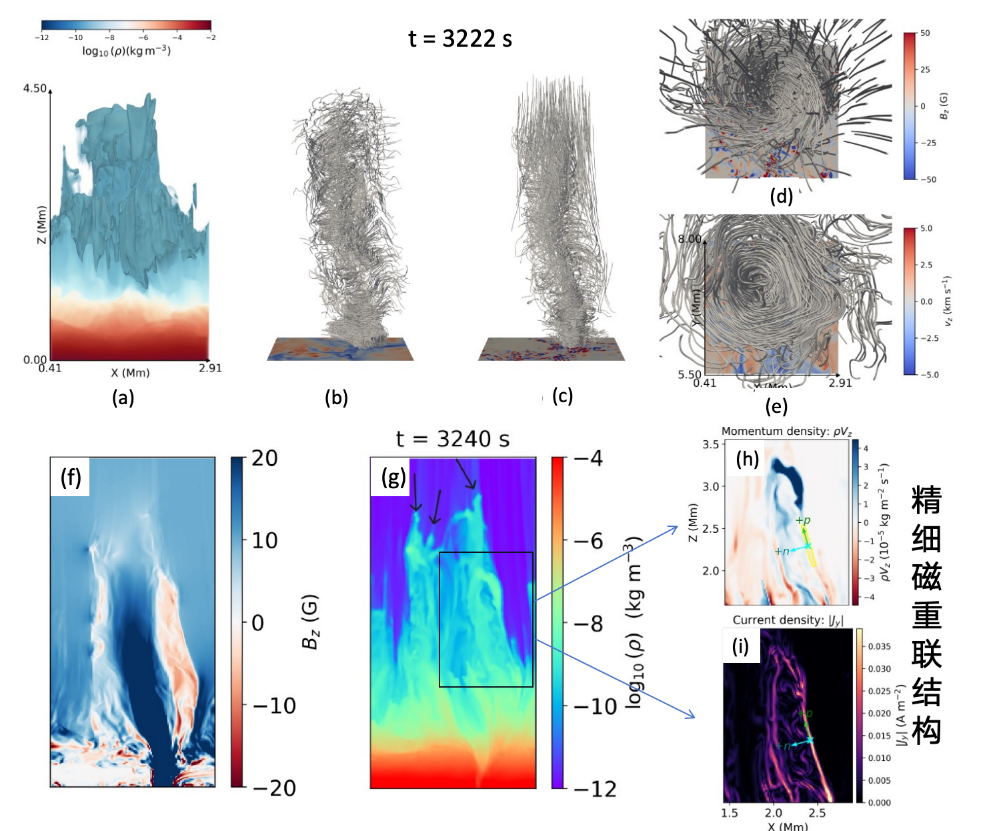
Figure 1: The upper row shows the three-dimensional structure of the rotating spicule-like jet and magnetic tornado. (a) Jet morphology reconstructed from the plasma density distribution. (b, c) Velocity streamlines and magnetic field lines viewed from the same angle. (d, e) Top views of the magnetic tornado. The lower row shows (f) the vertical magnetic field and (g) density in an x-z cross-section of the spicule, together with (h) vertical momentum density and (i) the magnitude of the y-component of current density in a local region. Image by GONG.
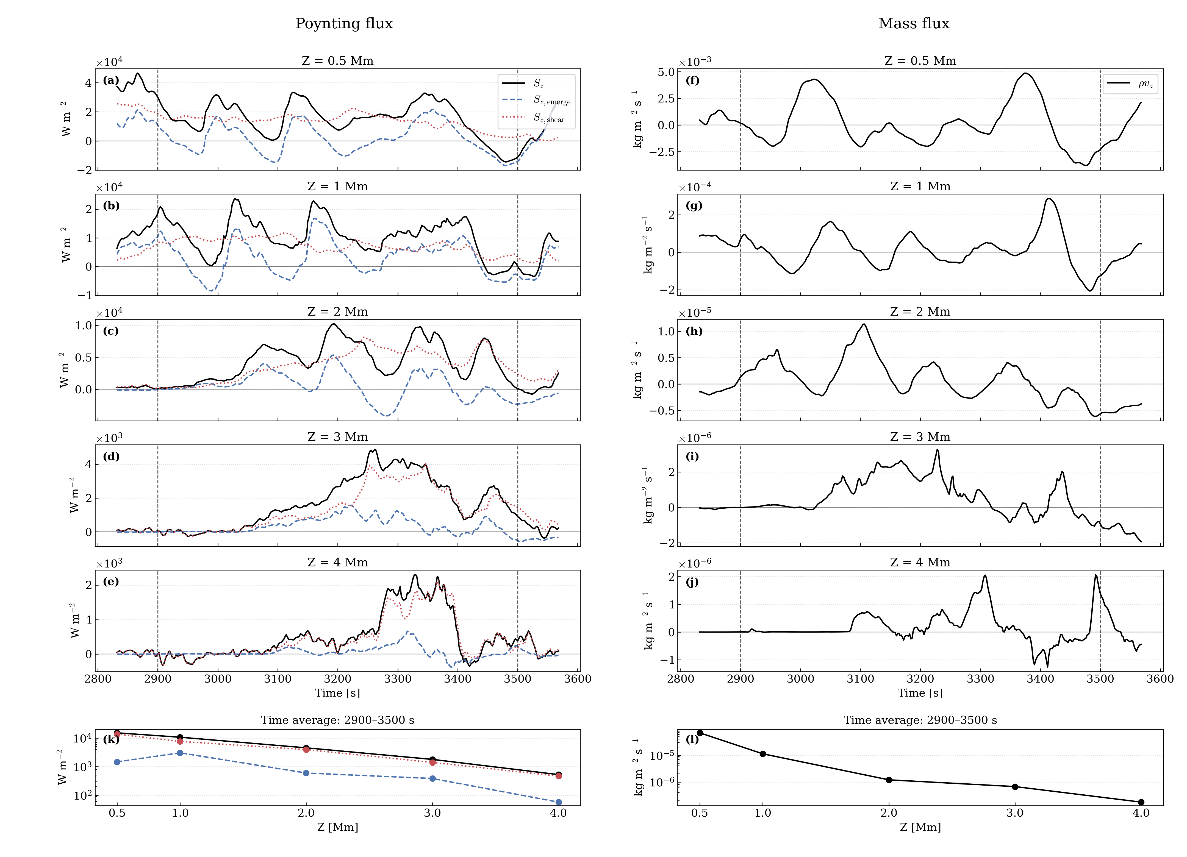
Figure 2: Variations in the mean vertical Poynting flux density and mass flux density with time and height. The left and right columns show the Poynting flux density and mass flux density, respectively. The bottom row shows their time-averaged values over the event's lifetime as functions of height. Image by GONG.
Contact:
GONG Liufan
Yunnan Observatories, CAS
e-mail:gongliufan@ynao.ac.cn