Ph.D. student LI Luhan, together with Prof. WANG Bo, Prof. ZHANG Jujia, from the Yunnan Observatories of the Chinese Academy of Sciences, carried out multi-band photometric and spectroscopic monitoring of the extremely faint Type IIP supernova SN 2024abfl. The team revealed unusual properties of this event in luminosity, plateau duration, line velocities, and nickel yield, providing a new observational case for understanding the diversity of core-collapse supernovae toward the low-mass end. The results have been published in the international journal The Astrophysical Journal.
Type IIP supernovae are widely recognized by their relatively flat plateau light curves lasting for an extended period after explosion, with the plateau emission closely tied to hydrogen recombination. In recent years, astronomers have identified a class of low-luminosity Type IIP supernovae that are significantly fainter and show slower spectral line velocities. These events are often associated with lower explosion energies and smaller yields of radioactive nickel, but their exact explosion channels—including whether more complex mechanisms such as electron capture might be involved—remain unclear.
SN 2024abfl was discovered in its host galaxy NGC 2146. Because this galaxy is interacting with a companion, different distance indicators yield clearly discrepant distance estimates. The team discusses two distance solutions in parallel: a shorter distance scale anchored mainly on Type IIP supernova distance methods, and a longer distance scale based primarily on galaxy kinematics, the Tully–Fisher relation, and globular-cluster-based estimates. Using data from the Lijiang 2.4 m telescope, the Xinglong 2.16 m telescope, public time-domain surveys (ZTF and ATLAS), and Swift/UVOT, the team performed long-term multi-band follow-up of SN 2024abfl. Notably, SN 2024abfl lies very close on the sky to SN 2018zd, another explosion in the same galaxy that has been widely discussed as an electron-capture supernova candidate, offering a rare opportunity to compare host extinction, luminosity, and spectral evolution between two neighboring events.
The analysis shows that SN 2024abfl’s plateau luminosity sits at the extremely faint end of the Type IIP population. Its plateau lasts about 110 days, corresponding to a relatively long plateau timescale. Spectroscopically, the Fe II line velocity measured at roughly 50 days after explosion is only about 1200 km s⁻¹—well below the 2000–5500 km s⁻¹ range commonly seen in many Type II-P supernovae at similar phases—indicating unusually slow expansion of the ejecta. Combined with bolometric light-curve modeling, the team further infers a synthesized nickel mass on the order of 0.002–0.004 solar masses, while emphasizing that this estimate is strongly tied to the uncertainty in the host-galaxy distance. At the same time, incorporating the progenitor identification from archival Hubble Space Telescope imaging, together with plateau colors, the magnitude drop from plateau to tail, and the overall spectral evolution, the team favors a low-luminosity Type IIP explosion produced by core collapse of a low-mass progenitor near the end of evolution, with an initial mass of about 8–12 solar masses.
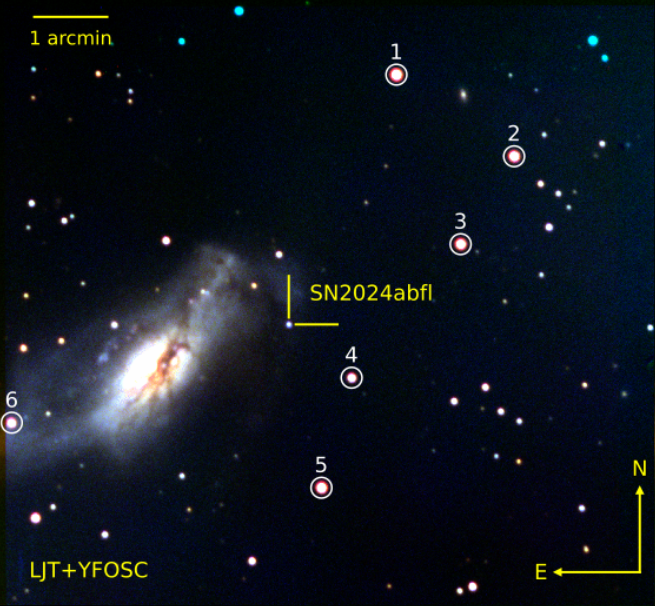
Figure 1: Image of the location of SN 2024abfl in NGC 2146. Image by LI.
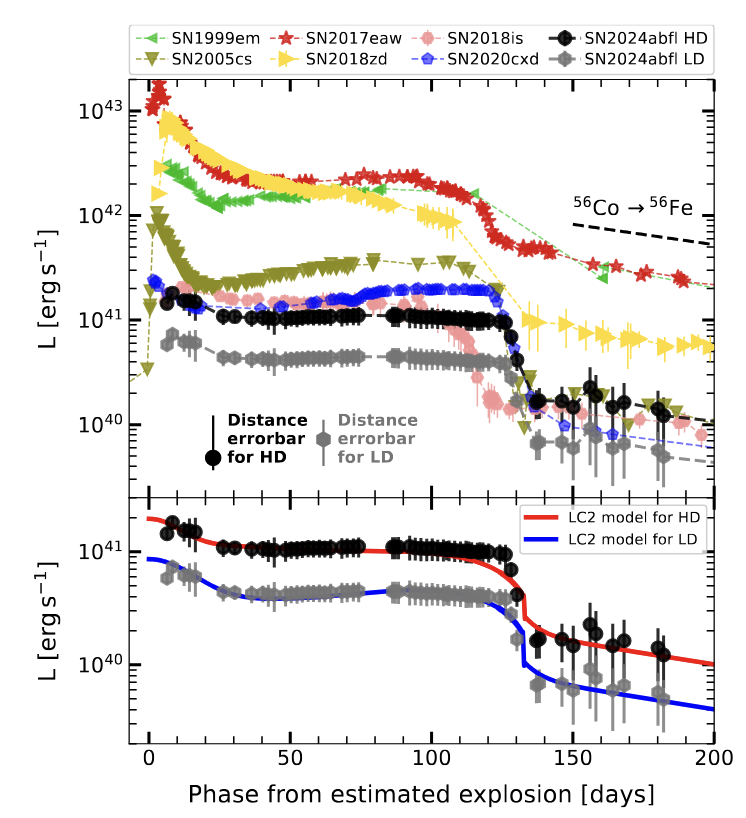
Figure 2: Bolometric luminosity evolution of SN 2024abfl, along with that of other well-studied SNe II. The bottom panel presents the two-component model fits to the SN 2024abfl light curves. Image by LI.
Contact:
LI Luhan
Yunnan Observatories, CAS
e-mail:liluhan@ynao.ac.cn


