Doctoral student ZHANG Zhengyang, along with Researcher WANG Bo at the Southern Base of Yunnan Observatories (Chinese Academy of Sciences) and international collaborators, has developed two neural-network surrogate models to tackle the long computation times previously required for physical-parameter inference from large samples of Type II supernovae. These models enable rapid, high-precision generation of multiband light curves. The work, titled “Surrogate models for type II supernovae: Probing low-energy explosions and interaction-free regimes,” was published in Physical Review D.
As time-domain surveys such as the Zwicky Transient Facility (ZTF) and the Legacy Survey of Space and Time (LSST) continue to operate, the number of supernova discoveries is expected to surge in the coming years. Traditional radiation-hydrodynamic simulations can describe post-explosion spectral and light-curve evolution in detail, yet Bayesian parameter inference for a single event typically takes several days—a bottleneck that hampers large-sample analysis and rapid physical characterisation.
To overcome this hurdle, the team designed two surrogate models based on the STELLA radiation-hydrodynamic simulation grid, each tuned to a distinct physical regime. The interaction model focuses on low-energy, low-luminosity Type II supernovae that may interact with dense circumstellar material, whereas the photospheric model addresses typical Type IIP supernovae that are not significantly affected by such interaction. Both models share a two-stage architecture—spectral compression followed by physical-parameter mapping—and incorporate latent-space mixup regularisation to improve interpolation stability and spectral reconstruction accuracy across continuous parameter spaces.
Tests demonstrated that both models achieved normalised reconstruction errors of approximately 10⁻⁴ for time-dependent spectral energy distributions. They successfully reproduced key evolutionary features, including the rapid early rise, plateau-phase evolution, and late-time decline. Compared with direct simulations, the method reduced the time required for complete Bayesian parameter inference for an individual Type II supernova from several days to several minutes.
The team then applied the models to representative events—supernova (SN) 2005cs, SN 2012aw, and SN 1999em. For the low-luminosity SN 2005cs, the model supported a low-mass red-supergiant progenitor and suggested that its early evolution might have been affected by interaction with dense circumstellar material, offering a fresh physical explanation for previous discrepancies in progenitor-mass estimates. For SN 2012aw and the typical Type IIP SN 1999em, the inferred progenitor masses were broadly consistent with earlier pre-explosion imaging and observational studies, confirming the method’s applicability under different explosion environments.
This work provides an efficient tool for the physical analysis of the large Type II supernova samples expected from upcoming surveys. It will support statistical investigations of explosion properties, progenitor masses, and pre�explosion mass�loss behaviour, thereby deepening our understanding of late-stage massive-star evolution and core-collapse mechanisms.
The research received support from the National Natural Science Foundation of China, the Chinese Academy of Sciences, the National Key R&D Program of China, relevant Yunnan provincial science and technology programs, and the International Centre of Supernovae at Yunnan Observatories.
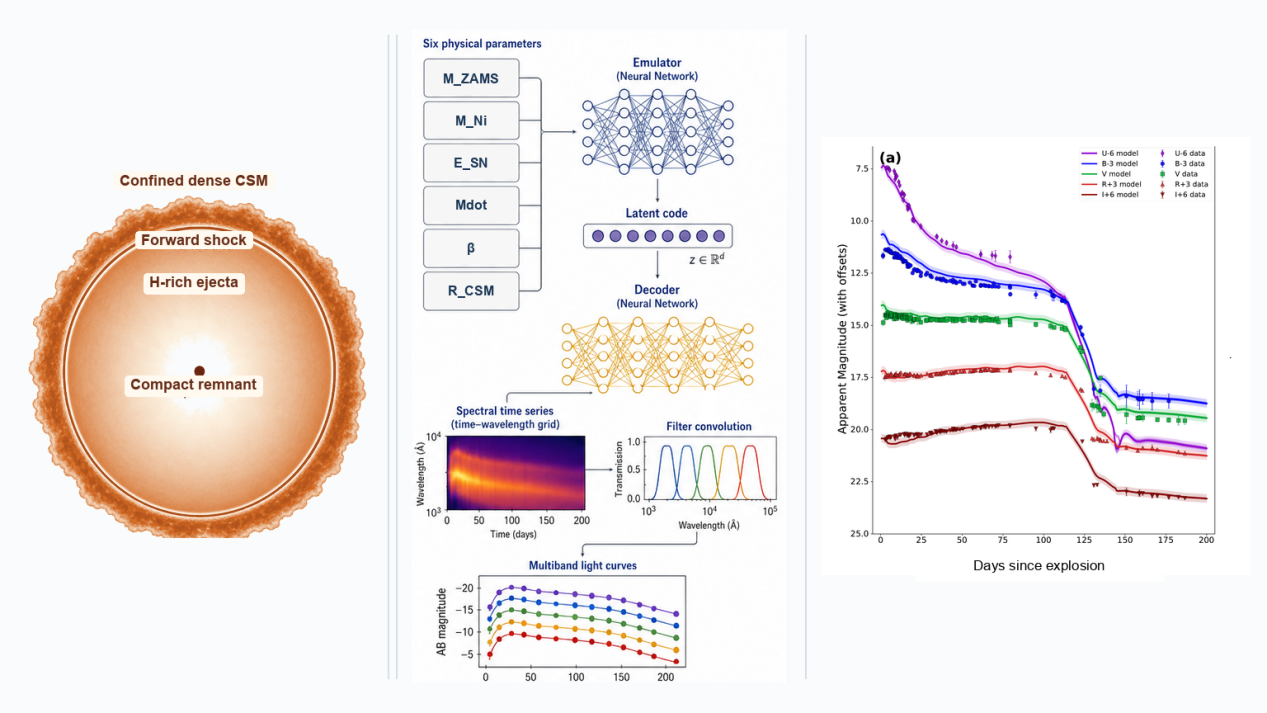
Figure 1. Explosion structure of SN 2005cs, neural-network surrogate model, and light-curve fitting results. The model generates theoretical multiband light curves from progenitor and explosion parameters and fits them to observed data, enabling rapid inference of the supernova’s physical properties. Image by ZHANG.
Contact:
ZHANG Zhengyang
Yunnan Observatories, CAS
e-mail:zhangzhengyang@ynao.ac.cn


