Recently, PhD student LI Yangji, Prof. BAI Jinming, and their collaborators at Yunnan Observatories, Chinese Academy of Sciences, analyzed long-term data collected by the Fermi Large Area Telescope (Fermi-LAT) aboard the Fermi Gamma-ray Space Telescope. They reported a gamma-ray excess toward the radio-quiet narrow-line Seyfert 1 galaxy 1H 1934-063. The results were published in The Astrophysical Journal Letters.
Narrow-line Seyfert 1 galaxies are a class of active galactic nuclei characterized by relatively low black-hole masses and high accretion rates. The gamma-ray-emitting narrow-line Seyfert 1 galaxies established to date are predominantly radio-loud and are generally interpreted within a relativistic-jet framework. Whether radio-quiet systems can also produce significant high-energy emission remains an open question in high-energy astrophysics. The nearby galaxy 1H 1934-063 exhibits rapidly variable X-ray emission but comparatively weak radio emission, making it an important target for investigating high-energy activity in radio-quiet active galactic nuclei.
The research team analyzed nearly 17 years of Fermi-LAT data collected between August 2008 and July 2025. The most prominent gamma-ray enhancement toward the source occurred during Modified Julian Date (MJD) 58788–59031. In the 1–500 GeV band, the excess reached a test statistic (TS) of 27.12, corresponding to a nominal significance of approximately 5.2σ. The best-fit gamma-ray position was consistent with the radio position of 1H 1934-063, while the nearby cataloged gamma-ray source FL16Y J1936.9–0552 was not significantly detected during the same interval. These results made 1H 1934-063 a plausible counterpart to the gamma-ray excess, although they did not establish a formal association. Further analysis indicated that the signal was concentrated mainly in the approximately 8–63 GeV energy range.
Analysis of the broadband spectral energy distribution showed that, within a representative one-zone leptonic model, synchrotron self-Compton emission alone was insufficient to reproduce the hard gamma-ray feature. Adding an external Compton component provided an illustrative phenomenological description of the observations. However, because the multiwavelength measurements were not obtained simultaneously and the Fermi-LAT spectrum was sparsely sampled, the physical origin of the emission could not yet be uniquely determined. Nonthermal particles in the corona, a transient weak jet, or other localized high-energy activity may all contribute. Future simultaneous X-ray and high-frequency radio observations, improved gamma-ray photon statistics during future active states, and high-resolution radio imaging will help clarify the mechanism responsible for gamma-ray production in radio-quiet active galactic nuclei.
This work was supported by the National Key Research and Development Program of China.
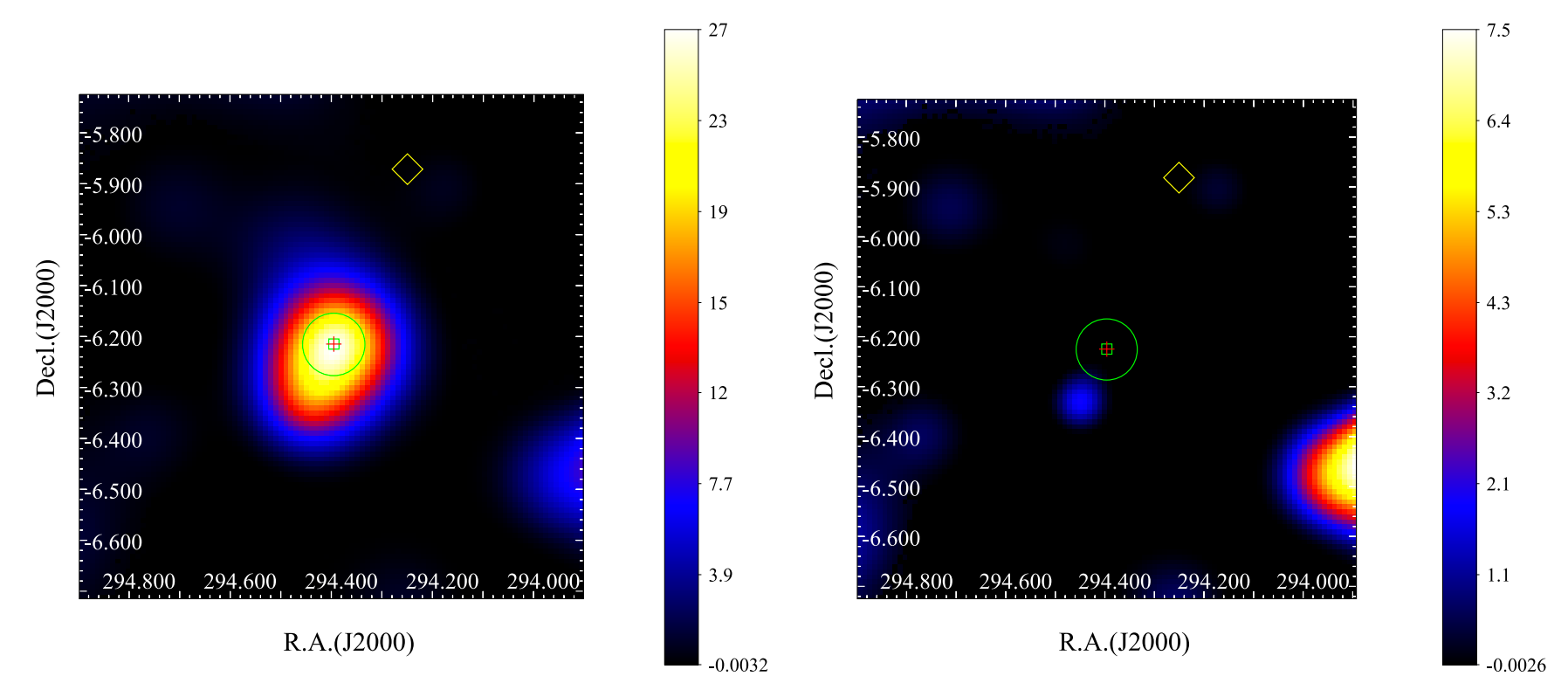
Figure 1. Test-statistic map (left) and residual map (right) in the 1–500 GeV band during the active interval of 1H 1934−063. Imaged by LI.
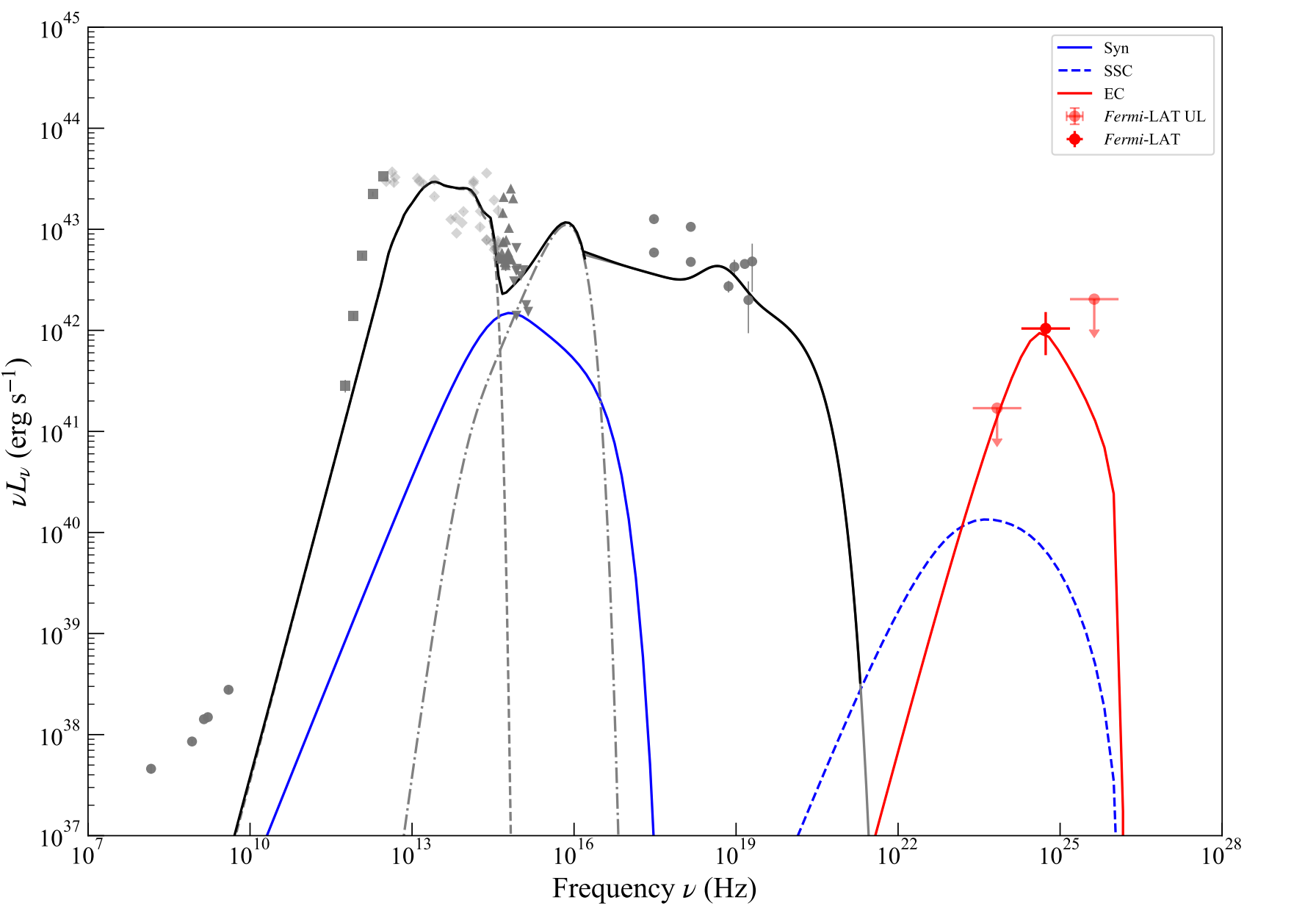
Figure 2. Nonsimultaneous broadband spectral energy distribution of 1H 1934−063. Image by LI.
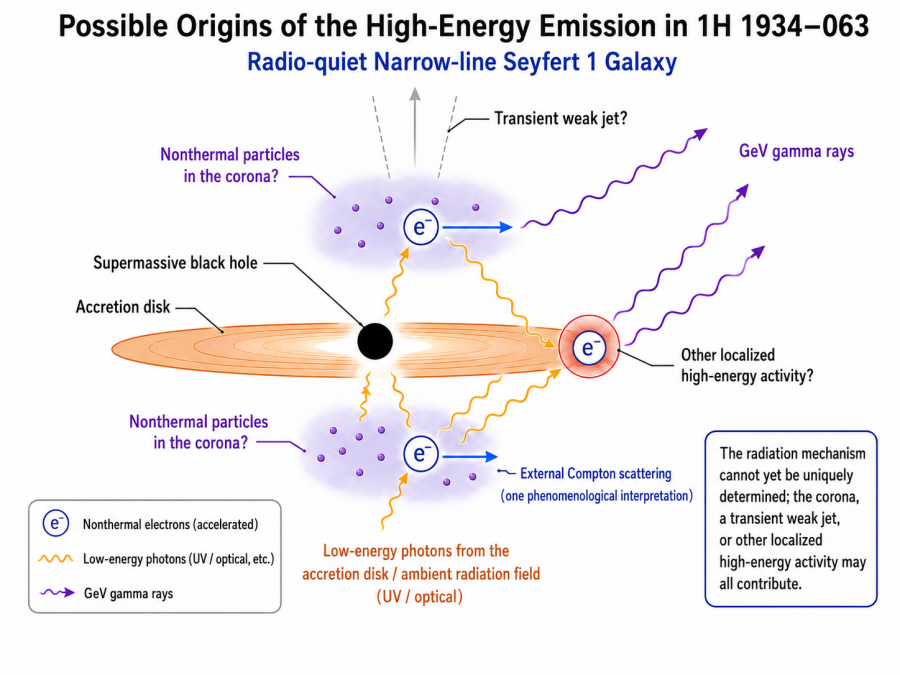
Figure 3. Schematic illustration of possible origins of the GeV gamma-ray excess toward 1H 1934−063. Image by LI.
Contact:
LI Yangji
Yunnan Observatories, CAS
e-mail:liyangji@ynao.ac.cn


