Researchers led by YANG Bo at Yunnan Observatories, Chinese Academy of Sciences, have published a study in The Astrophysical Journal Letters. Using high-cadence, high-resolution observations from several ground- and space-based solar telescopes, the study has revealed for the first time the complete physical process behind recurrent brightenings within a fishbone-like magnetic structure in a solar active region, providing new insight into how magnetic energy is released on fine scales in an orderly fashion in the solar atmosphere.
The team combined observations from the New Vacuum Solar Telescope (NVST), the Solar Dynamics Observatory (SDO), the Interface Region Imaging Spectrograph (IRIS), and the Hinode satellite, and identified a series of recurrent small-scale brightenings near the southeast edge of active region 12297 on March 11–12, 2015. High-resolution observations showed that the source region lay between two negative-polarity sunspots, with a narrow, elongated strip of positive-polarity magnetic field in between. The fishbone-like magnetic structure sat precisely there: a “spine” ran along the positive-polarity strip, while a series of “herringbone” branches extended obliquely from both sides of the spine to connect to the two negative-polarity sunspots. Over roughly 9.5 hours of continuous observations, the team identified 18 distinct brightening events, each lasting about 9 minutes on average, with recurrence intervals ranging from 13 to 59 minutes (about 29.7 minutes on average), corresponding to a frequency of about 1.91 events per hour.
These brightenings did not occur randomly, but advanced in an orderly fashion, like a zipper being pulled open. During the events, a compact bright feature traveled node by node from west to east along the spine of the fishbone-like structure, at an average speed of a dozen or so kilometers per second, comparable to the Alfvén speed in the chromosphere and transition region. Meanwhile, bidirectional flows appeared along the branches on both sides, and plasma blobs were ejected along the spine toward a distant positive-polarity sunspot region. The researchers suggest that the traveling bright feature may have successively recorded magnetic reconnection occurring one after another, in chronological order, at successive “nodes” along the spine, rather than the bulk motion of plasma. The entire energy-release process may have taken place mainly in the chromosphere and transition region.
The study further found persistent magnetic flux emergence and shearing motions in the photosphere beneath the fishbone-like structure, possibly accompanied by flux cancellation. On the one hand, these photospheric activities could maintain the complex topology of the structure; on the other, they may have continuously replenished its free magnetic energy, driving the brightenings to recur.
In terms of the physical picture of energy release, the study offers the following insight: the fine-scale release of magnetic energy can be highly ordered. Previous observations have mostly treated active-region brightenings as isolated, sporadic events, whereas this study shows that, organized by a coherent magnetic structure, successive brightenings can take place in relay along a specific “path,” node by node, forming a recurrently operating “energy-release engine.” The study may provide new clues to the physical mechanism behind recurrent brightening processes in active regions.
The findings also bear on the problem of chromospheric and coronal heating. Solar physicists have long conjectured that coronal magnetic field lines, braided by photospheric convective motions, form tangled magnetic structures whose internal, cascading bursts of small-scale reconnection, known as a “magnetic avalanche”, may be an important mechanism of coronal heating, but such processes have rarely been captured directly by observations. This study provides a rare observational sample and further suggests that such braided magnetic structures, together with their accompanying cascading energy release, are more likely to occur in the chromosphere and transition region, which deviate from force-free conditions, and can persist there over long periods while operating repeatedly. These results thus may provide new observational evidence for Parker's coronal heating theory and for small-scale energy release in the framework of self-organized criticality.
The work was supported by the National Key R&D Program of China, the National Natural Science Foundation of China, the Yunnan Fundamental Research Projects, and the Yunnan Xingdian Talent Program.
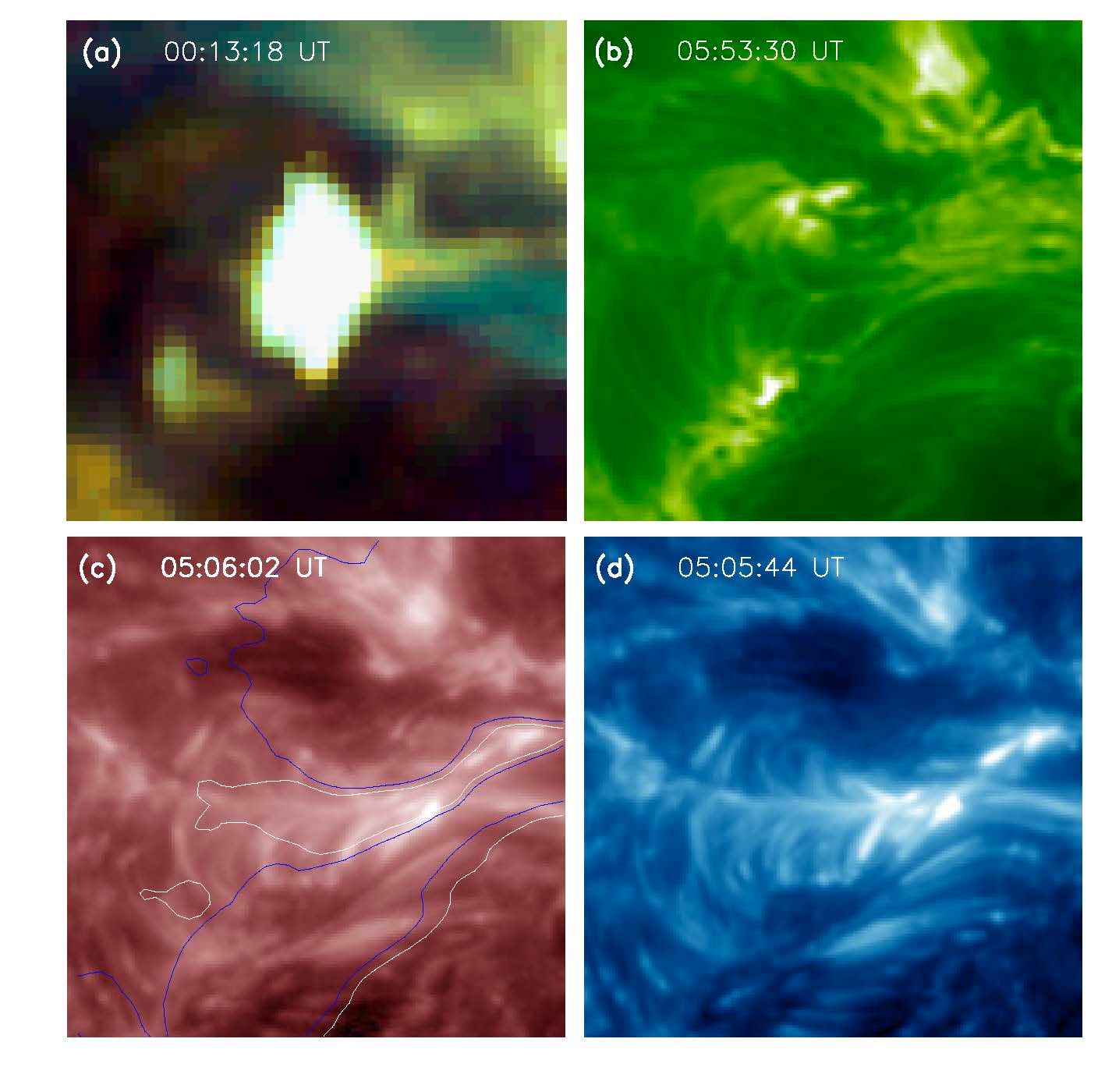
Figure 1: Coronal brightenings and the fishbone-like magnetic structure in the source region. (a) Composite of SDO/AIA 171 Å (red), 193 Å (green), and 131 Å (blue) images; (b) NVST Hα line-core image; (c)–(d) IRIS/SJI 1330 Å and 1400 Å images. White and blue contours indicate line-of-sight magnetic fields of ±200 G. Image by YANG.
Contact:
YANG Bo
Yunnan Observatories, CAS
e-mail:boyang@ynao.ac.cn


