A theoretical study by PhD student NIE Meng and Prof. MAO Jirong from Yunnan Observatories, Chinese Academy of Sciences, has systematically examined the linear polarization properties of synchrotron radiation produced by electrons with very small pitch angles. The research, published in The Astrophysical Journal under the title “Linear Polarization of Synchrotron Radiation from Very-small-pitch-angle Electrons,” provides a framework for describing polarization in extreme astrophysical environments where conventional synchrotron theory no longer applies.
Synchrotron radiation is one of the most important radiation mechanisms in the universe and is widely observed in pulsars, gamma-ray bursts, and other high-energy astrophysical environments. When relativistic electrons move in magnetic fields, their radiation carries information about the electron energy distribution and magnetic field strength, while its linear polarization properties offer additional insights into electron dynamics and magnetic field configurations. Conventional synchrotron radiation theory generally assumes that the electron pitch angle—the angle between the electron velocity and the magnetic field—is much larger than the opening angle of the radiation cone. However, in realistic astrophysical environments, processes such as ordered magnetic field structures, particle acceleration, and radiative cooling may cause electrons to move almost parallel to the magnetic field. This results in highly anisotropic distributions with very small pitch angles, under which conventional theory is no longer applicable.
To address this gap, the researchers built on the theoretical formalism of very-small-pitch-angle synchrotron radiation and integrated over the corresponding electron energy distributions. They considered nonthermal power-law electrons, thermal Maxwellian electrons, and hybrid distributions containing both components. The calculations covered the radio, optical, X-ray, and gamma-ray bands, with particular attention to how magnetic field strength, electron power-law index, electron temperature, and the transition point between thermal and nonthermal components affect the polarization degree.
The results show that both thermal and nonthermal electrons can produce significant linear polarization through very-small-pitch-angle synchrotron radiation, although the polarization degree is generally lower than that predicted by conventional synchrotron radiation. For nonthermal power-law electrons, the polarization degree remains approximately constant over a broad frequency range, exhibits a characteristic peak at low frequencies, and shows a cutoff at high frequencies. For thermal Maxwellian electrons, the polarization degree displays an approximately single-peaked profile as a function of frequency, reaching a maximum value of about 70.7%. The peak frequency shifts toward higher frequencies as the magnetic field strength and electron temperature increase. For hybrid distributions, the polarization gradually transitions from nonthermal-electron-dominated to thermal-electron-dominated as the transition point between the two components changes, exhibiting complex dependencies on physical parameters across different frequency bands.
The study systematically reveals the linear polarization properties of very-small-pitch-angle synchrotron radiation from different electron distributions, demonstrating that the electron pitch-angle distribution is an important factor influencing synchrotron polarization. The results provide a new theoretical perspective for understanding polarization phenomena that cannot be adequately described by conventional synchrotron radiation theory. According to the researchers, these findings may contribute to a better understanding of particle energy distributions and magnetic field environments in high-energy astrophysical sources such as pulsars and gamma-ray bursts, and provide a theoretical basis for distinguishing different radiation mechanisms through future multiwavelength polarization observations. Further investigations incorporating polarized radiative transfer, depolarization, and Faraday rotation may help establish a more comprehensive theoretical framework for synchrotron polarization.
This research was supported by the National Natural Science Foundation of China, the National Key Research and Development Program of China, and the Yunnan Revitalization Talent Support Program.
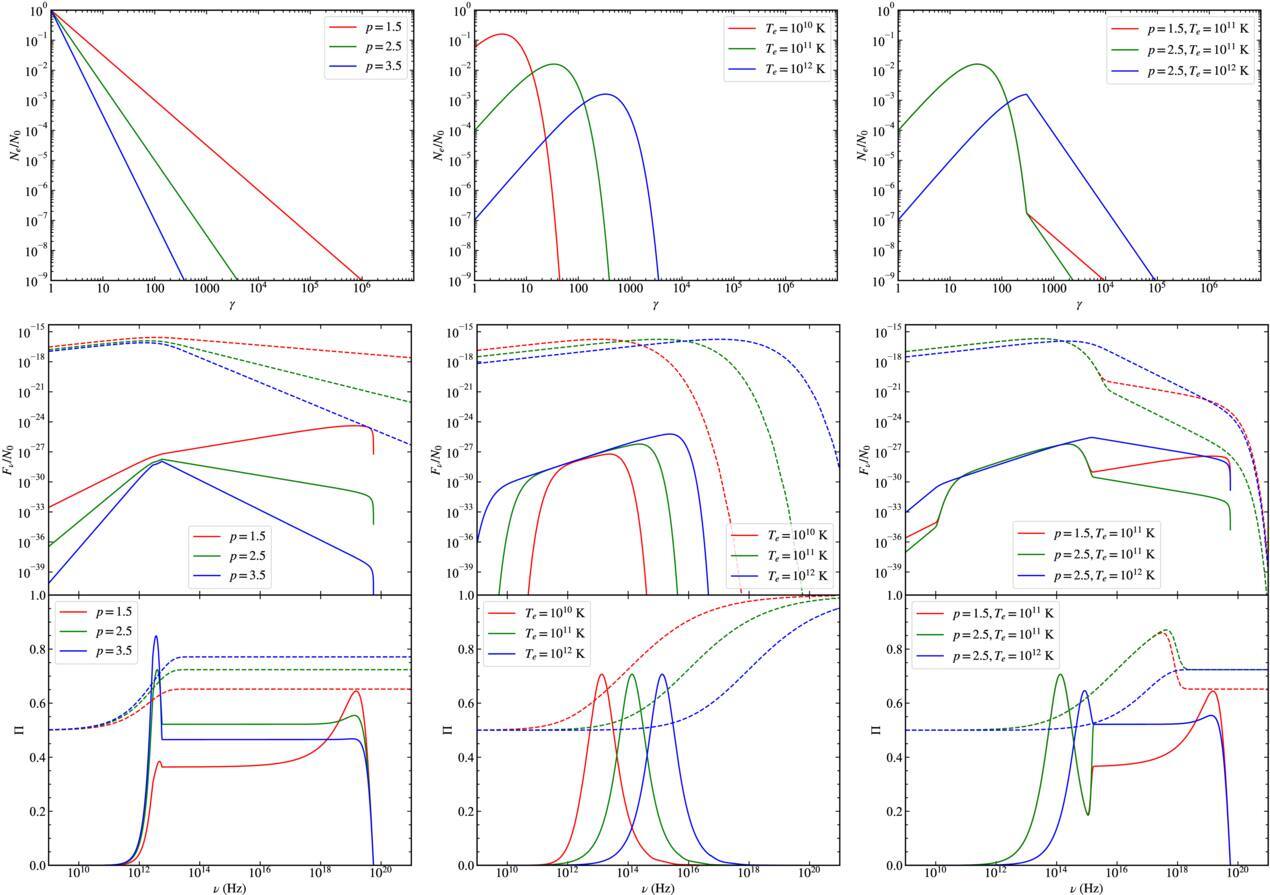
Figure 1: spectral and linear polarization properties of synchrotron radiation for different electron energy distributions. The left, middle, and right columns correspond to nonthermal power-law, thermal Maxwellian, and hybrid thermal–nonthermal electron energy distributions, respectively. The top, middle, and bottom rows show the electron energy distributions, spectra, and linear polarization degrees, respectively. Solid and dashed lines represent the calculated results for very-small-pitch-angle synchrotron radiation and conventional synchrotron radiation, respectively. Image by NIE.
Contact:
NIE Meng
Yunnan Observatories, CAS
e-mail:niemeng@ynao.ac.cn


