Researchers at Yunnan Observatories, Chinese Academy of Sciences, have conducted a detailed study of the highly active M-type spectroscopic binary system TIC 349005337 using observational data from the Large Sky Area Multi-Object Fiber Spectroscopic Telescope (LAMOST) and the Transiting Exoplanet Survey Satellite (TESS). The work precisely measured the physical parameters of both component stars and captured 12 optical stellar flare events, providing new observational evidence for understanding magnetic activity in low-mass stars and its connection to their internal structure. The results were recently published in The Astrophysical Journal.
M-dwarf stars are the most numerically dominant stellar population in the Milky Way and serve as foundational benchmarks for exploring the structure and evolution of low-mass stars, as well as exoplanetary habitability environments. Through observations of eclipsing binaries, astronomers can directly measure stellar masses and radii with high precision, independent of theoretical models. However, stellar evolution theory has long faced a prominent “radius inflation” problem: the measured radii of many M dwarfs are significantly larger than predicted by theoretical models. A widely held view attributes this discrepancy to strong magnetic fields, high rotation rates, and extensive starspot coverage on stellar surfaces, which inhibit convective energy transport. To decipher this underlying physical mechanism, finding and accurately characterizing highly active M-type eclipsing binary systems is important.
ZHOU Xiao and collaborators performed systematic physical modeling and analysis of the M-type detached eclipsing binary system TIC 349005337, combining high-cadence continuous light curve data from TESS with multi-epoch spectroscopic analysis from the LAMOST Medium-Resolution Survey (LAMOST-MRS). They obtained the fundamental physical parameters for both component stars. The mass of the secondary star falls below the fully convective boundary (about 0.35 solar masses), indicating that it is a fully convective star. Observational data for both components display significant radius inflation. Even after accounting for starspot coverage and third-light contamination, the inflation effect remains prominent, offering an observational benchmark for refining low-mass stellar evolution models.
Across approximately 65.1 cumulative days of TESS observations, the research team identified 12 optical flare events from the light curve of TIC 349005337, yielding an average system flare detection rate of approximately 0.18 events per day. Among these, the most energetic event was a superflare with an estimated radiative energy release of about 3.87×1034 erg. In solar magnetic dynamo models, the tachocline—the shear boundary layer between the radiative core and the convective envelope—plays a vital role in magnetic field generation and evolution. The secondary component of TIC 349005337 is a fully convective star lacking a solar-like tachocline. If a portion of these high-energy flares can be confirmed to originate from the secondary star, these events would demonstrate that fully convective stars can still build up and release substantial magnetic energy even without such a shear layer.
The highly active magnetic behavior and frequent flaring observed in TIC 349005337 make it a natural laboratory for investigating binary tidal interactions, magnetic field generation mechanisms in low-mass stars, and stellar atmospheric stability. The research team also highlighted that the high-frequency superflares and intense high-energy radiation released by such systems—with significant X-ray emission already detected by the ROSAT satellite—pose a threat to the atmospheric stability of potential exoplanets in the habitable zone, potentially inducing atmospheric stripping or altering photochemical evolution. Future multi-wavelength joint observations, such as X-ray, extreme ultraviolet, and high-resolution spectroscopy, will further probe the coronal properties and long-term magnetic evolution of this system.
This work was supported by the International Partnership Program of the Chinese Academy of Sciences, the Young Talent Project of the Yunnan Revitalization Talent Support Program, and the Yunnan Fundamental Research Projects.
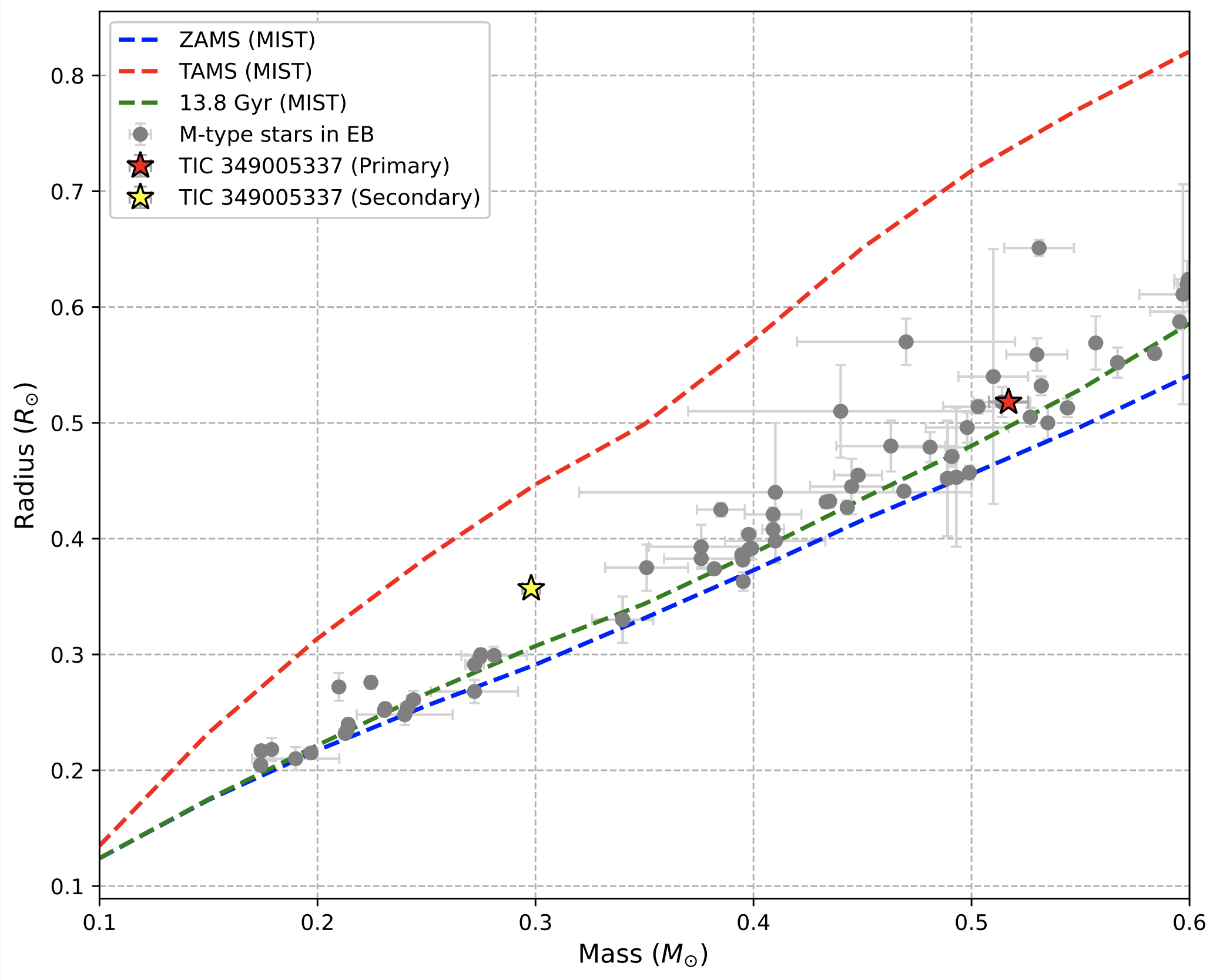
Figure 1: Mass–radius relation for low-mass stars (M≤0.6M⊙). Image by ZHOU.
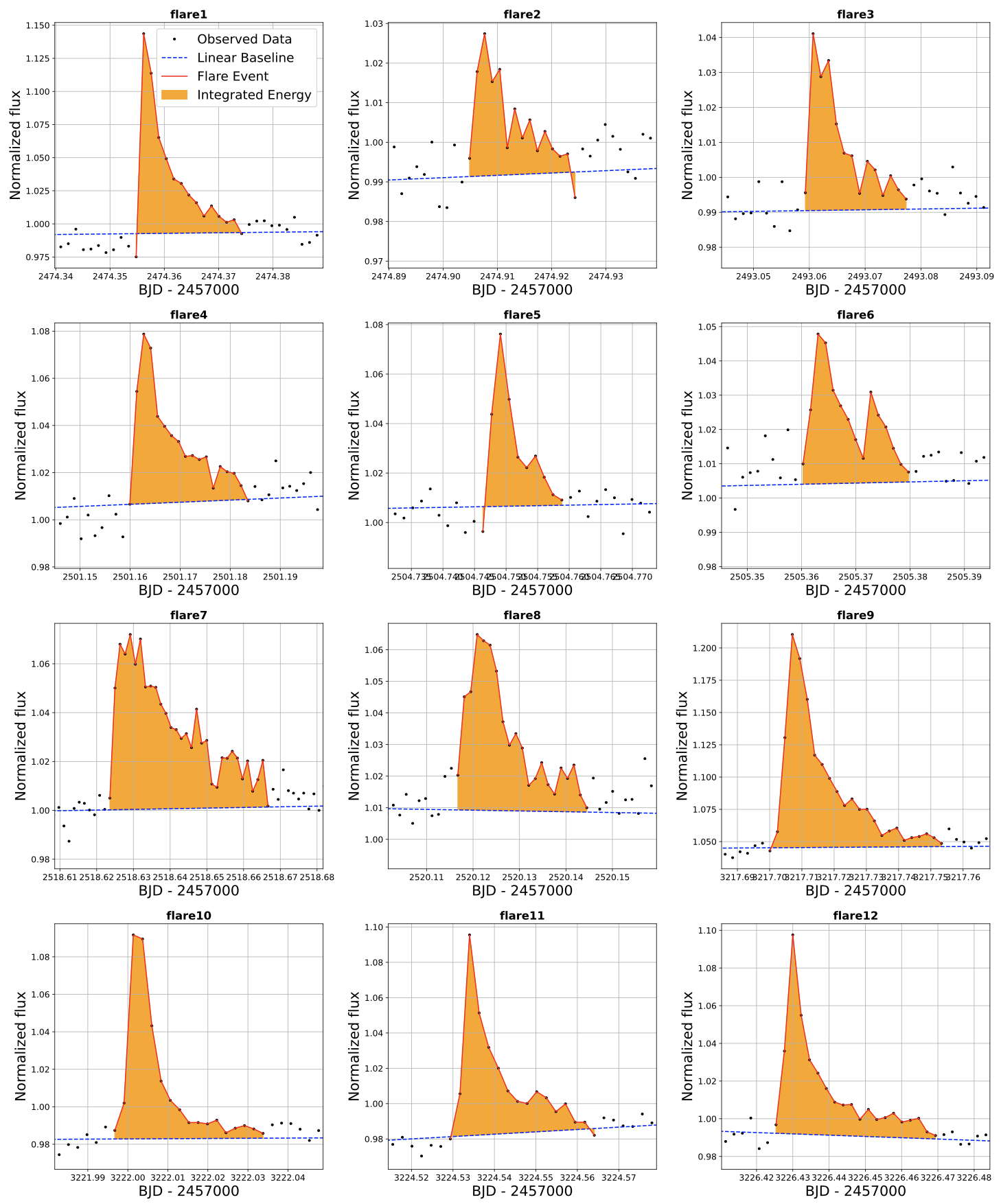
Figure 2: 12 optical flares detected in the TESS light curve of TIC 349005337. Image by ZHOU.
Contact:
ZHOU Xiao
Yunnan Observatories, CAS
e-mail:zhouxiaophy@ynao.ac.cn


