Recently, Dr. LI Liping and Prof. ZHANG Jujia of the Southern Astronomical Observatory of Yunnan Observatories, along with their collaborators, conducted observational studies on a high-velocity Type Ia supernova (SN Ia), SN 2024gy, using the Lijiang 2.4-meter telescope. Their findings, published in The Astrophysical Journal, provide new observational evidence for the "delayed-detonation" model of SNe Ia.
SNe Ia are produced by thermonuclear explosions of carbon-oxygen white dwarfs in binary star systems. As crucial "standard candles" in the universe, they play a key role in the discovery of the accelerated expansion of the cosmos and in measuring cosmological distance. However, their progenitor systems and explosion mechanisms remain debated. Observations show that some SNe Ia exhibit pronounced high-velocity features (HVFs) in their early-phase spectra. The physical origin of these HVFs and their connection to the explosion mechanism remain a topic in active research. Precisely constraining the explosion mechanism of SNe Ia is of fundamental importance for enhancing their reliability as cosmological probes.
In this study, researchers utilized the Lijiang 2.4-meter telescope of Yunnan Observatories, in collaboration with facilities including the Xinglong 2.16-meter telescope of the National Astronomical Observatories, the Yunnan University 1.6-meter Multi-Channel Photometric Survey Telescope, the 0.8-meter Tsinghua–NAOC telescope, the Shane 3-meter telescope at Lick Observatory in California, USA, and the Keck I telescope in Hawaii. They obtained multi-band photometric and spectroscopic evolution data of SN 2024gy from approximately 2 days to over 400 days after its explosion. The observational data indicate that SN 2024gy is a normal luminosity SN Ia, exhibiting strong HVFs of calcium in its early-phase spectra that are independent of the photospheric component.
This study captured the velocity evolution of various components in the early-phase spectra of SN 2024gy, indicating that the significant velocity disparity may reflect the distinct ionization states of different intermediate-mass elements in the outermost ejecta. The observed HVFs of calcium in the spectra of SN 2024gy, along with the layered velocity structure between silicon and calcium, align well with effects such as ionization suppression or density enhancement predicted by the delayed-detonation model in the outer ejecta.
Furthermore, the nickel-to-iron abundance ratio derived from the emission lines of iron-group elements in the late nebular-phase spectra also falls within the theoretical range predicted by the delayed-detonation model. These coherent pieces of evidence, spanning from early-phase dynamics to late-phase nucleosynthesis products, collectively support the physical scenario of delayed detonation.
This study provides crucial observational constraints for understanding the outer-layer structure and explosion mechanisms of SNe Ia. A deeper comprehension of early spectral features such as high-velocity components is essential for ultimately revealing the nature of their progenitor systems and refining explosion models, which will further enhance the precision of SNe Ia as cosmological distance-measuring tools.
This work was supported by the National Key R&D Program of China, the B-type Strategic Priority Program of the Chinese Academy of Sciences, the National Natural Science Foundation of China, the Top-notch Young Talents Program of Yunnan Province, and etc.
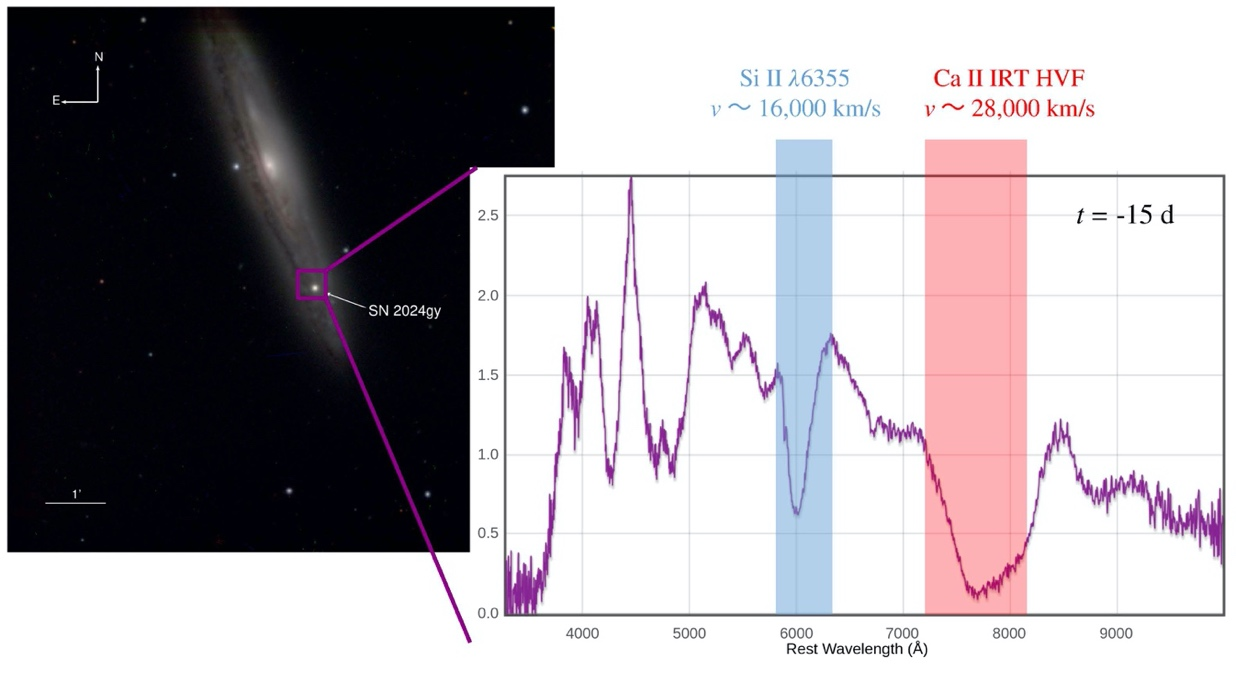
Figure 1: SN 2024gy originated from the host galaxy NGC 4216, and its early-phase spectra (taken 15 days before maximum light) exhibited extremely strong HVFs of calcium. Image by LI.
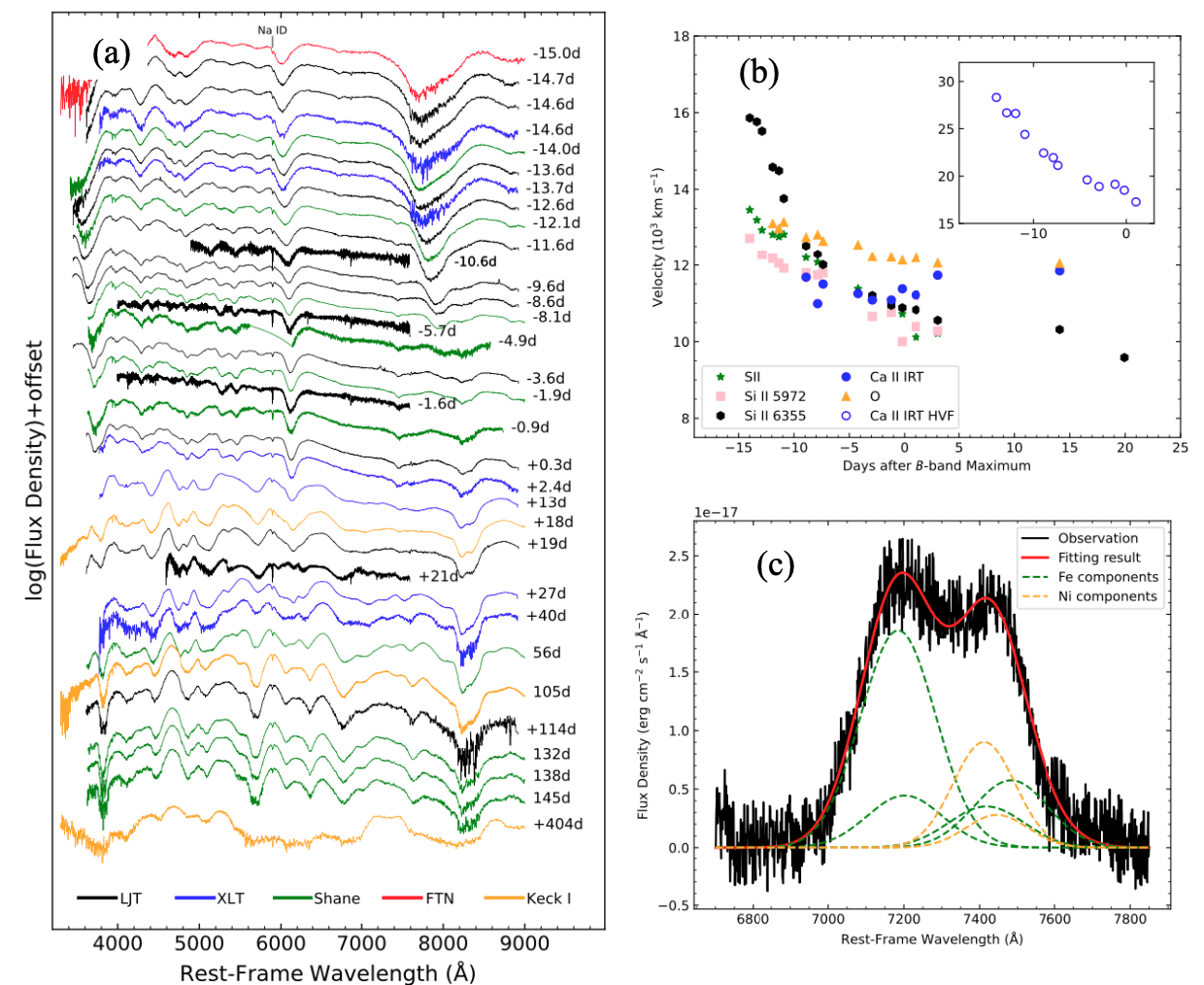
Figure 2: (a) Spectral evolution of SN 2024gy; (b) velocity evolution of different elements in the spectra; (c) the fitting for the Ni and Fe component in the late-time spectra. Image by LI.
Contact:
LI Liping
Yunnan Observatories, CAS
e-mail:liliping@ynao.ac.cn


