Researchers from the Stellar Astrophysics Group at Yunnan Observatories, Chinese Academy of Sciences, in collaboration with KU Leuven in Belgium, have developed a new asteroseismic method to identify stars that have undergone rapid mass transfer in binary systems. The findings were published in Astronomy & Astrophysics.
Asteroseismology, an effective method for probing stellar internal physical properties and accurately determining fundamental stellar parameters, has been widely applied in exoplanet detection, binary star evolution, and galactic structure studies. Mass transfer is a critical physical process in binary system evolution, but its typically short duration poses challenges for direct observational detection. During rapid mass transfer, core physical quantities undergo significant redistribution, reshaping the stellar internal structure. These structural modifications can leave long-lasting traces, which asteroseismology is theoretically capable of detecting. Nevertheless, previous studies lacked systematic theoretical support, making it difficult to identify stars that have experienced rapid mass transfer directly from observational data.
This study used theoretical modeling and numerical simulations to analyze how rapid mass transfer alters the internal structure and oscillation patterns of main-sequence stars. When a star undergoes rapid mass loss, surface pressure decreases first, triggering a chain reaction of declining internal pressure and temperature. This slows the thermonuclear reaction rate in the core, contracts the central convective region, and forms a chemical abundance transition zone with double gradient surfaces outside the convective core. This zone modulates seismic wave propagation, leading to characteristic periodic variations in stellar pulsation signals.
For g-mode pulsations (buoyancy-dominated modes), these variations manifest in the period spacing distribution. In conventional single-gradient structural models, period spacing exhibits a single periodic variation with period or radial order. In contrast, models with double-gradient surfaces display dual-periodic behavior in period spacing as a function of period or radial order. The frequency of this dual-periodic signal correlates directly with the position of the gradient surface (i.e., the location of a sharp increase in buoyancy frequency).
For p-mode pulsations (pressure-dominated acoustic modes), periodic variations are observed in the ratio r of small to large frequency separations. Conventional structural models show a monotonic decrease in r with frequency, whereas double-gradient models exhibit additional periodic oscillations in r with frequency or radial order. The frequency of these oscillations corresponds to the location of the chemical gradient surface (where the sound speed structure changes abruptly).
In stars undergoing mass accretion, steeper chemical gradient surfaces develop. These produce notable differences in the amplitude, frequency, and morphology of period spacing variations compared to conventional models. Such distinctions, however, require comparative analysis with theoretical models for accurate identification and cannot be confirmed from observational data alone.
The asteroseismic diagnostic method established herein allows direct screening of stars that have undergone rapid mass loss from observational data. Combined with detailed numerical simulations, it further constrains key parameters of binary mass transfer—such as initial mass distribution, timing, and rate of mass transfer—providing critical support for understanding binary star evolution.
This work was supported by the National Natural Science Foundation of China Basic Science Center Program, the Chinese Academy of Sciences Strategic Priority Research Program, the National Key Research and Development Program of China, and the Yunnan Province Basic Research Program.
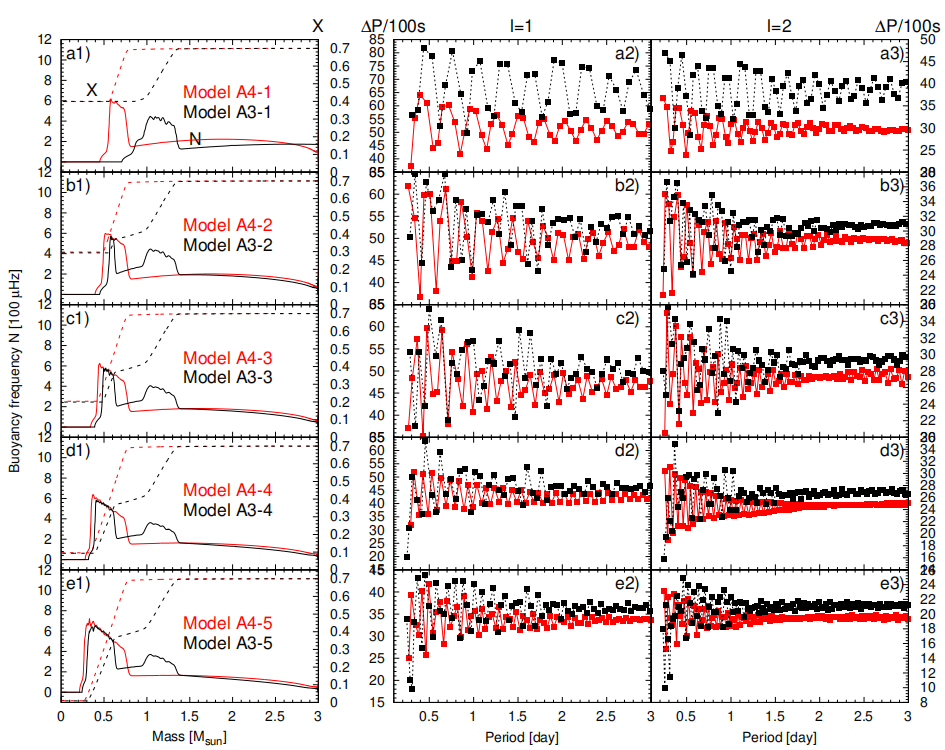
Figure 1: Comparison between the rapid mass loss model (black curve: 4.5 Msun → 3.0 Msun) and the conventional model (red curve: 3.0 Msun) for a typical upper main-sequence star (4.5 solar masses). The left panel shows the distribution characteristics of hydrogen abundance (X, dashed line) and buoyancy frequency (N, solid line); the middle and right panels display the period spacing as a function of period for spherical harmonic degrees l=1 and l=2, respectively. Image by WU.
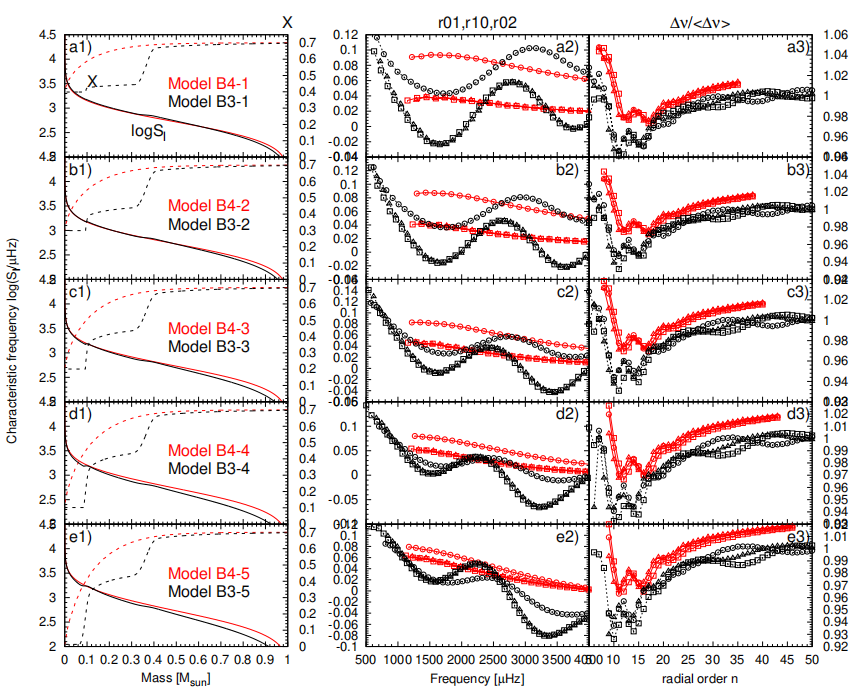
Figure 2: Comparison of p-mode pulsation characteristics between the rapid mass loss model (black curve: 2.0 Msun → 1.0 Msun) and the conventional model (red curve: 1.0 Msun). The left panel shows the distribution of hydrogen abundance (X, dashed line) and acoustic characteristic frequency (Sl, solid line); the middle and right panels present the small-to-large frequency spacing ratio r and the large frequency spacing Δν as functions of frequency, respectively. Image by WU.
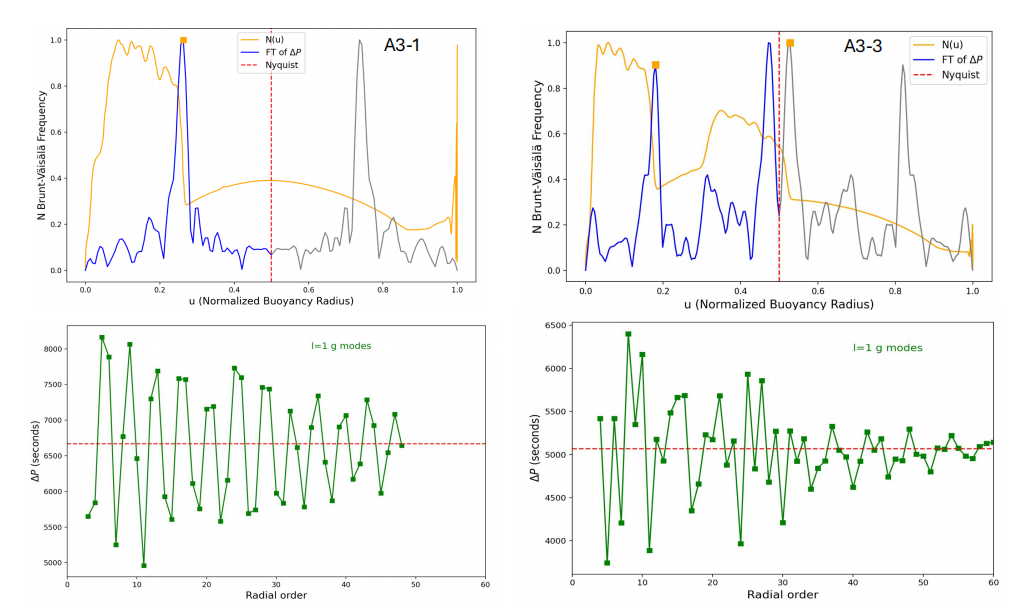
Figure 3: Period spacing changes (lower panels) and period spacing frequency analysis results (upper panels: blue markers + gray solid lines) of the star before (left panel) and after (right panel) rapid mass loss. In the upper panels, the yellow solid line represents the buoyancy frequency, and the red dashed line represents the Nyquist frequency. Image by WU.
Contact:
WU Tao
Yunnan Observatories, CAS
e-mail:wutao@ynao.ac.cn


