A new theoretical study clarifies how dark matter halos influence the physical properties and observational characteristics of accretion disks around black holes. The research, a collaboration between the Stellar Physics Group at Yunnan Observatories, Chinese Academy of Sciences, and the College of Physics, Guizhou University, has been published in The European Physical Journal C.
In 2019, the Event Horizon Telescope (EHT) produced the first image of the M87 supermassive black hole, showing a bright emission ring around a central shadow. The ring comes from synchrotron radiation in the hot accretion flow, while the shadow marks the region where photons are captured. Its size, shape, and brightness pattern depend on the black hole’s mass, spin, viewing angle, and the properties of the surrounding matter. These image features carry key information about accretion dynamics, magnetic fields, and possible dark matter halos.
The study systematically investigates the radiative properties and observational images in strong gravitational fields of geometrically thin accretion disks surrounding Schwarzschild black holes embedded in Dehnen-type dark matter halos. It reveals that the distribution of dark matter has a measurable impact on accretion processes and the observation of black hole shadows.
Based on the classical Novikov–Thorne model, the team analyzed changes in the accretion disk’s energy flux, temperature distribution, and emission spectrum when a black hole is embedded in a dark matter halo with specific density parameters (ρₛ) and scale radius (rₛ).
The results show that as the parameters ρₛand rₛincrease, the overall radiation intensity and temperature of the accretion disk decrease significantly. The underlying physical mechanism is that the additional gravitational potential provided by the dark matter weakens the gravitational binding energy released during the accretion process, causing the disk to become colder and dimmer.
A key finding is that the presence of dark matter significantly alters the observational image of the black hole in a strong gravitational field. As ρₛ and rₛ increase, both the primary and secondary images of the accretion disk expand outward in both the horizontal and vertical directions, and this expansion becomes particularly pronounced at high inclination angles. This implies that the apparent size of the black hole's shadow and photon rings increases due to the presence of the dark matter halo.
This study indicates that under fixed conditions of black hole mass, accretion rate, and observation angle, the properties of the dark matter halo leave observable and distinct imprints on the thermodynamic behavior of the accretion disk and its visual morphology. These manifest as two key signals: Firstly, a systematic suppression of the radiative flux and temperature of the accretion disk under identical conditions; Secondly, an anisotropic increase in the apparent size of the black hole shadow and photon ring, particularly more pronounced in high-inclination systems.
These theoretical predictions provide a new approach for using high-resolution observational instruments (such as EHT) to detect the density distribution of dark matter around supermassive black holes at galactic centers. By comparing EHT imaging and spectral data with theoretical models incorporating dark matter effects, it is expected that future observations will effectively constrain or detect the density profile of dark matter in galactic centers.
This research was collaboratively completed by Dr. LI Zhi from Yunnan Observatories and Dr. YU Jiancheng from Guizhou University.Supported was provided by theNational Natural Science Foundation of China's Basic Science Center, the National Key R&D Program of China, the Key Program of the National Natural Science Foundation of China, and the International Centre of Supernovae, Yunnan Key Laboratory.
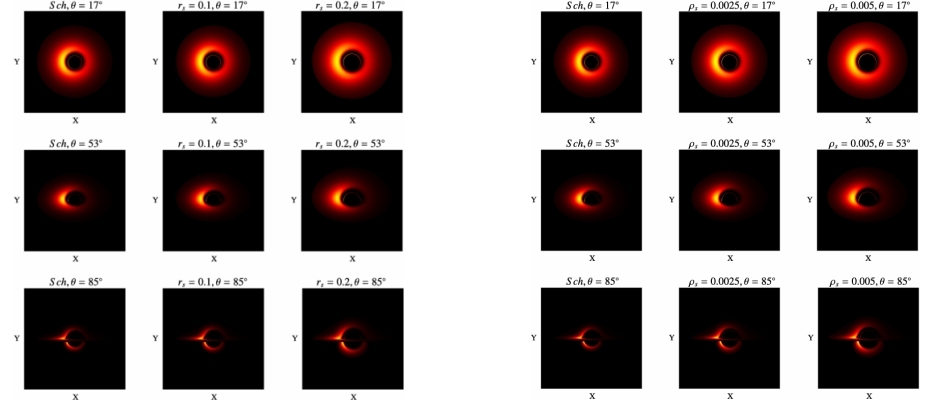
Figure 1. Full apparent images of thin accretion disks at different inclination angles. The left panel is for a fixed ρₛ = 0.03, and the right panel for a fixed rₛ = 0.5. The leftmost column in each panel represents the Schwarzschild black hole. Image by LI.
Contact:
LI Zhi
Yunnan Observatories, CAS
e-mail:lizhi@ynao.ac.cn


